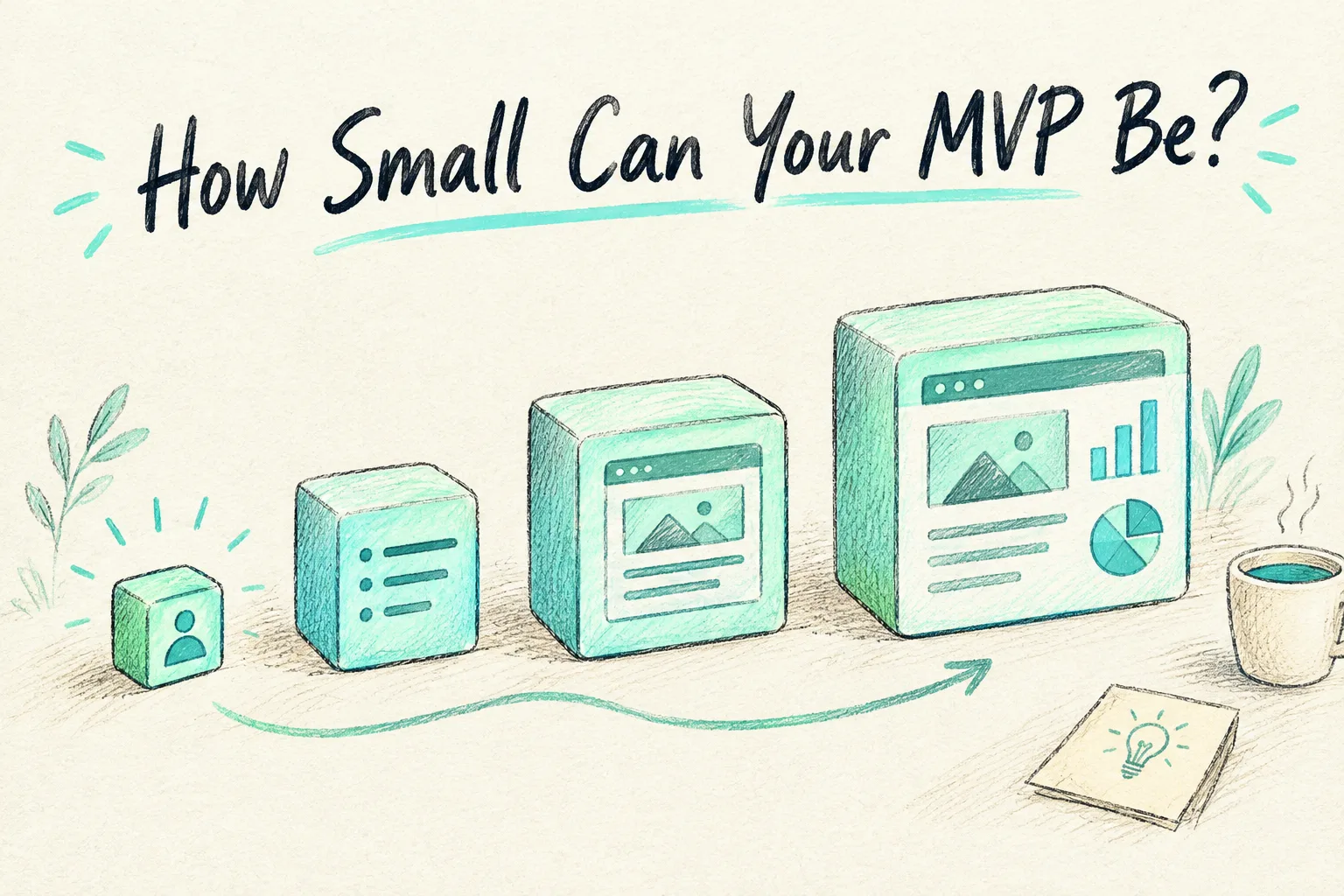
Defining the right scope for a minimum viable product is harder than it looks. Too small, and you learn nothing useful. Too big, and you burn time and budget before you even meet real users. The key is to translate an idea into one focused journey that tests your riskiest assumptions fast, with just enough functionality to deliver a clear outcome.
Getting the size question right
When an MVP is too small
An MVP is too small when users can’t reach a real outcome, even if they like the idea. If your first version feels like a prototype that only demonstrates screens, not value, you’ll learn mostly about your pitch, not your product. A good check is whether early adopters can complete one job end-to-end without workarounds. If they can’t, the feedback becomes hypothetical and hard to act on.
When an MVP is too big
An MVP is too big when you’re building a full app to remove uncertainty that you could have tested with simpler slices. Extra features often sneak in to satisfy every potential client, cover edge cases, or match competitors, but they dilute focus. In product management terms, the scope expands faster than learning, and delivery becomes the goal instead of discovery. The result is a long cycle with weak signals.
You can spot an oversized MVP by looking at what’s driving decisions: assumptions about what users might want “later,” complex conception work to support many segments, or architecture “just in case.” For marketplaces, the warning sign is trying to launch supply, demand, pricing, messaging, and trust all at once. If you can’t explain what single core problem you’re testing, you’re paying for optionality.
Finding the learning sweet spot
The right size sits where build-measure-learn runs fast and the product still delivers a credible value proposition. You want a narrow set of characteristics that lets real utilisateurs behave naturally, not politely. That means choosing tests that turn your biggest assumption into observable behavior and collecting user feedback that changes decisions. The sweet spot is minimum to prove one thing and no more.
- Define the one user action that proves value, then keep only features that enable a complete first outcome.
- Treat every added screen as an assumption; ship only what makes behavior measurable.
- Prefer simple flows over flexibility; constrain choices to reduce noise in feedback.
- Cap the effort so you can run a second iteration quickly; optimize for short learning loops.
If you’re unsure between two sizes, pick the smaller one that still produces a real transaction, commitment, or repeated usage. Learning requires friction: if users won’t sign up, share data, pay, or return, you’ve discovered something important. Conversely, if you need weeks of polish before anyone can try it, you’ve slipped from MVP into product discovery by committee. Aim for evidence over opinions.
Moving from idea to MVP
Clarifying problem, user and context
Start by writing a single real pain you aim to solve, then name who feels it and what “better” looks like. Keep it concrete: what triggers the need, what blocks progress, and what outcome the user is trying to achieve. This is the heart of product discovery and the quickest way to check whether your value proposition is specific enough to build toward.
Define a clearly bounded situation where the problem happens: device, workflow, frequency, and constraints like time, trust, or compliance. This context prevents vague solutioning and helps you spot the earliest reachable segment, often early adopters with an urgent need. At this stage, a lightweight prototype can validate comprehension and desirability without committing to full implementation.
Listing and ranking assumptions
List everything that must be true for your first version to work, then treat each item as unknowns that can kill the project. In product management, this makes the build-measure-learn loop actionable: you are not “building an MVP”, you are selecting the smallest build that can falsify the biggest risks before you scale scope or spend months engineering.
- Write down the pain is frequent enough to justify a new habit or purchase.
- Capture whether they try to solve it today with workarounds or competitors.
- State what must be true for they will switch for this benefit you offer.
- Check distribution: you can reach them cheaply through one or two channels.
- Validate feasibility: the team can deliver fast with current skills and systems.
Rank your list by impact and uncertainty, then test the riskiest first with the cheapest evidence you can gather. That might be a concierge flow, a landing page, or a thin app slice that generates real user feedback. The goal is not to prove you are right; it is to learn fast which assumptions hold before you invest in a broader build.
Selecting one narrow user journey
Pick one end-to-end path that starts with a real trigger and ends with a measurable user success, and ignore side routes for now. This keeps the first version coherent and testable: one persona, one context, one outcome, with clear entry and exit criteria. If you are building marketplaces, choose a single interaction (for example, one side posting and the other responding) rather than trying to launch the full ecosystem at once.
Scoping your minimum viable product
Cutting features without losing value
You can cut features aggressively as long as the product still delivers a clear outcome on the core problem in a single, narrow moment of use. Keep what proves the value proposition end-to-end, and remove anything that exists to “complete” the app rather than validate it. The goal is one convincing success path, not a polished first version.
A practical way to decide what survives is to map each feature to an assumption it tests and to the user feedback it could generate from early adopters. If a feature doesn’t change what you can learn, it’s scope noise. In product discovery and product management, this is how you avoid building a prototype that looks impressive but answers nothing.
Aligning minimum viable product with constraints
Your scope has to match real constraints first, because time, team skills, data access, and compliance can silently redefine what’s viable. For a custom web application, constrain the MVP to what you can ship with predictable engineering risk: one workflow, limited roles, manual back-office where needed, and minimal integrations. This keeps the build-measure-learn loop fast without betting on complex marketplaces, elaborate conception, or fragile dependencies.
After launch: learn and expand
What to measure in early usage
In early usage, measure whether people reach the promised outcome, not whether they merely click around. Your first version should test the riskiest assumption behind the value proposition and the core problem, especially with early adopters. Focus on signals that show real progress for utilisateurs and clients, then relate them back to the scope you shipped in the app and the features you intentionally left out.
- Track time to first value from signup to the first meaningful result
- Define a single activation event that indicates the product is working
- Watch repeat behavior within 7 days to see if the habit can form
- Measure drop-off points by step on the one journey you shipped
- Collect top 3 failure reasons when people abandon or churn
Combine metrics with user feedback so you understand the “why” behind the numbers. Short interviews, support tickets, and session recordings often reveal whether the problem is messaging, onboarding, or missing capability. If distribution happens via marketplaces, separate acquisition issues from product issues. Use simple cohorts to compare users who reach value versus those who do not, then update your assumptions before adding any new features.
Planning the next iteration steps
Plan the next iteration by turning what you learned into a clear decision, pivot or persevere, then into one testable hypothesis. Keep a steady build measure learn rhythm, but avoid expanding the minimum viable product into a vague “more complete” release. In product management, this is where product discovery continues, you refine what you believe, why it matters, and what proof would change your mind.
Translate the decision into a small backlog: one improvement to remove the biggest friction, one experiment to validate the next assumption, and only then a feature expansion. When uncertainty is high, use a prototype to explore the riskiest interaction before committing engineering time. Set a short timebox, define the success threshold up front, and ship only what directly improves the user journey you are validating.
Frequently asked questions
How long should it take to build a minimum viable product?
Between 2 and 8 weeks is a reasonable target for lauching a minimum viable product in most early-stage projects. Less than that often means rushed quality or unclear learning goals, while more increases risk and cost. The exact duration depends on complexity, team experience and how much you can reuse existing tools or components.
How much should I budget for an MVP as an early-stage founder?
A realistic MVP budget starts in the low five figures, then grows with complexity and compliance needs. Costs depend on whether you use freelancers, an agency or in-house staff, and on hidden items like design, infrastructure, and ongoing support. Clarifying scope and constraints early avoids both underfunding and unnecessary features.
What is the difference between an MVP, a prototype and a proof of concept?
An MVP is a real product used by real users, while a prototype or proof of concept is mainly for internal learning. A prototype explores user experience or flows without full functionality. A proof of concept validates that a specific technology or approach can work. An MVP combines both into something shippable in production.
Can I launch a minimum viable product without writing custom code?
Yes, you can launch using no‑code tools or existing SaaS products if they cover your core user journey. This often speeds up delivery of a minimum viable product and keeps costs low. The trade-off is limits on customization and scalability, but that is usually acceptable at the learning stage.