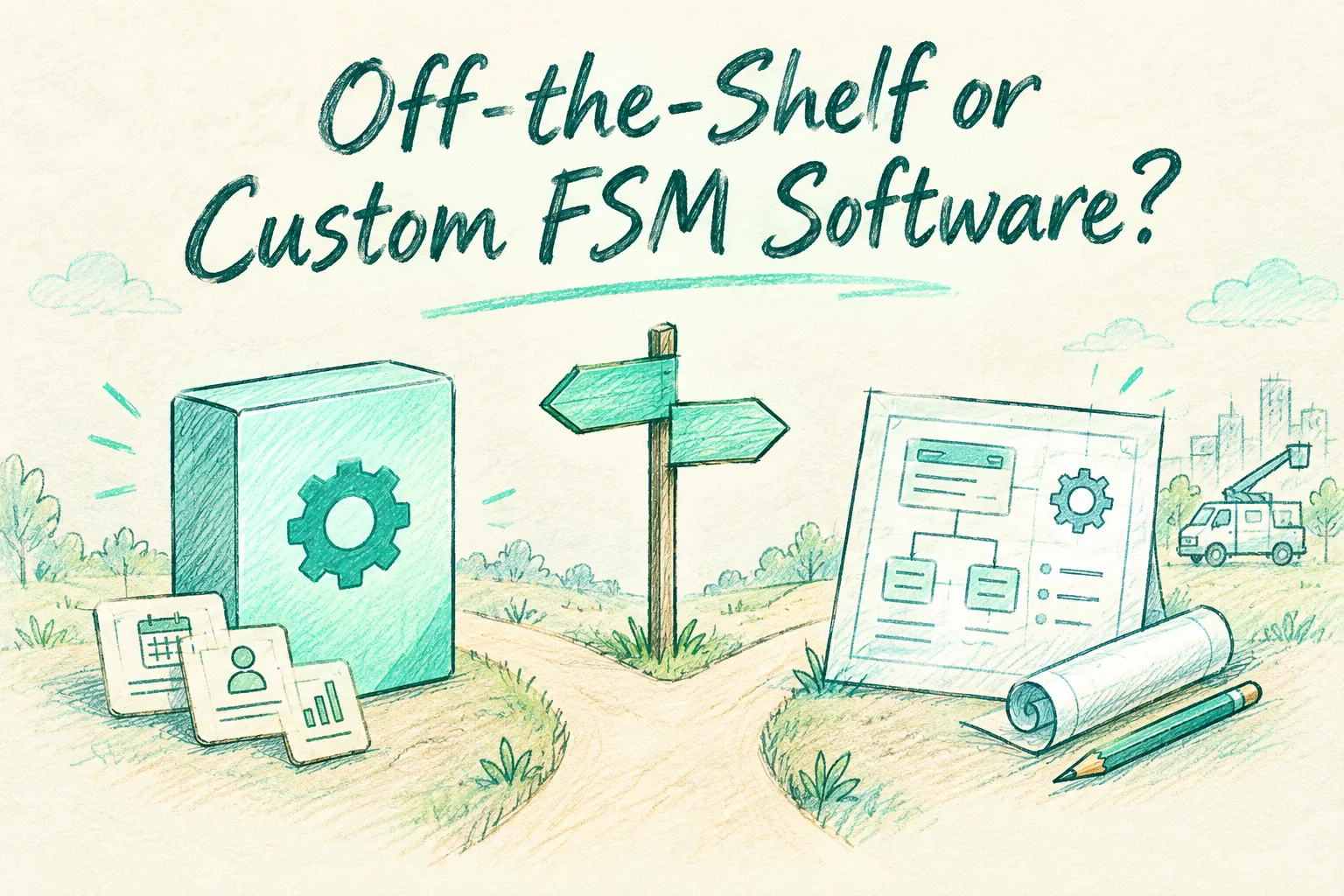
Choosing between off-the-shelf and bespoke field service tools is rarely a simple price comparison. The right option depends on how specific your workflows are, how regulated your industry is and how fast you need to move. Some teams gain speed with generic products. Others unlock real leverage only when their processes are encoded in custom-built software.
Choosing between off-the-shelf and bespoke
What field service management software actually does
Field service management software coordinates the full service cycle, from request to completion, by turning incoming demand into scheduled jobs, actionable work orders, and traceable outcomes. It typically covers dispatching, workforce management, parts and asset history, and customer communications, so teams gain end-to-end operational visibility across the field service operation.
In practice, value comes from execution details: technician apps for mobile use, reliable offline mode in poor coverage, time and materials capture, customer signatures, and clean handoffs into invoices. The best setups reduce duplicate entry and exceptions by keeping planning, execution, and billing aligned in one consistent workflow.
How off-the-shelf tools are designed and sold
Off-the-shelf software is built to serve many companies with broadly similar processes, so it ships with standard screens, predefined entities, and configurable rules rather than deep tailoring. Vendors package it as ready-to-use software with per-user licensing, add-ons, and implementation partners, positioning upgrades and scalability as benefits. You usually get configuration, templates, and some integration options, but the core model is fixed for predictable deployment speed.
What truly makes a solution bespoke in practice
A bespoke solution is custom software shaped around your actual operating model, not just a re-labeled configuration of standard modules. It matches your process fit at the points that usually break packaged tools, such as complex service contracts, nonstandard pricing, or a signature process for triage, scheduling, and proof of service, delivering fit where it matters.
The real differentiator is how it handles automation and integration across your stack: ERP and accounting, CRM, inventory, telematics, customer portals, and provider integrations for a mixed provider network. When your field service relies on independent contractors or multiple dispatch rules, bespoke design removes brittle manual workarounds and enables straight-through execution from request to invoice.
Bespoke also changes ownership: you choose whether it’s built as in-house software or with a development partner, and you control the roadmap, data model, and quality bar. That control comes with a maintenance burden, so “bespoke” is only real when your team plans for support, security, and continuous improvement to keep performance and scalability strong, ensuring long-term product control.
When off-the-shelf field service management software fits
Standard workflows and mature service industries
Off-the-shelf field service management software fits best when your operations look like the “default” model: dispatching technicians, handling work orders, capturing signatures, and closing out jobs with invoices. In many mature service industries, those flows are already well understood, so the standard feature set covers 80% without heavy tailoring.
You’ll get immediate value if your team can adopt the vendor’s way of working with minimal friction: technician apps for mobile use, basic workforce management, and simple customer communications. If your technicians operate in basements, plant rooms, or remote areas, offline capability matters more than tweaks, because it protects completion rates regardless of connectivity.
Cost, licensing and time-to-value constraints
Ready-to-use software is often the pragmatic choice when you need predictable spend and a fast rollout. Licensing can be easier to justify than funding custom software, especially if you’re scaling headcount or using independent contractors. Where operations are growing, a proven rollout playbook reduces risk, even if the tool isn’t a perfect match on day one.
- Pick a plan where adding users is linear, not a step-change in cost.
- Prioritize vendors with prebuilt dispatch templates that match your service cadence.
- Validate that mobile setup is simple for new technicians and contractors.
- Confirm reporting gives same-day visibility without a data project.
- Choose support that offers implementation guidance, not just a help center.
Off-the-shelf software also tends to win when the business can’t pause operations for a long build cycle. If you need scheduling, customer updates, and basic service contracts management quickly, speed beats perfection. You can usually extend later through configuration or light integration, while keeping the core system stable.
Living with limits and workarounds day to day
Off-the-shelf tools work long-term when the team can accept small gaps without constant friction. That means workarounds stay occasional, not daily manual workarounds that create errors or delay billing. If process fit is “good enough,” a bit of customization or a low-code platform extension can bridge minor needs. The red flag is when exceptions become the norm, because staff will route around the system and data quality will degrade.
When bespoke field service management software wins
Industry-specific workflows and regulatory needs
Bespoke field service management software wins when your operation can’t be expressed as generic “work order in, job out”. If compliance rules, certification checks, or client-specific service contracts shape every visit, a tailored flow can prevent non-compliant jobs before dispatch. It also supports industry-required evidence capture (photos, readings, timestamps), approval chains, and invoice logic that off-the-shelf software often handles only with fragile custom fields.
Automation, integrations and internal tooling
Bespoke field service software pays off when automation depends on multiple systems talking cleanly together. If dispatch decisions rely on inventory, skills, SLAs, or customer history spread across tools, deep integration removes double entry and keeps everyone aligned on the same data. Done well, it becomes one source of truth across teams, not another app that needs reconciliation.
This is especially true with complex provider networks: independent contractors, subcontractors, or partner crews may need different permissions, rate cards, and visibility. With a custom build, you can design role-based experiences, contractor onboarding, and provider integrations around real operational complexity, while preserving mobile use in the field and supporting offline mode where connectivity is unreliable.
Turning your unique service model into software
Bespoke becomes the right move when process fit is the business, not a nice-to-have. If your margins come from a signature process, differentiated scheduling, or bundled offerings, building a custom web application lets you encode those rules directly into the technician apps and back office, instead of living with manual workarounds that grow as you scale.
- Model dispatch around profit and SLA trade-offs, not just nearest technician
- Capture job outcomes with mandatory evidence at the right step, not after the fact
- Generate invoices with pricing rules that match contracts, including exceptions
- Expose customer updates as real-time visibility, reducing inbound calls
- Support growth with routing and capacity logic that evolves with your workforce
The key is treating the build vs. buy choice as a product decision: define what must be unique, then implement only that uniqueness. You still want maintainability, clear ownership, and measured scalability targets, because custom software can create a maintenance burden if requirements are not governed. When the unique model is stable and valuable, bespoke turns it into a durable operational advantage.
Making a decision for your service business
A simple build-versus-buy decision grid
A build-versus-buy grid turns your field service management software choice into a defensible decision by judging both options against the same operational signals. You are not comparing features in a vacuum: you are testing whether your reality (jobs volume, exceptions, service contracts, and mobile use) matches what the product expects, or whether your model needs custom software to stay efficient.
| Decision signal | Off-the-shelf is usually better when… | Bespoke is usually better when… |
|---|---|---|
| Process fit | Your work order flow matches standard patterns | Your signature process is the differentiator |
| Operational complexity | Low exceptions, few edge cases | Many variants, rules, approvals, SLAs |
| Integration needs | Few systems, standard connectors | Deep integration with internal tooling |
| Manual workarounds | Occasional workarounds are acceptable | Workarounds create recurring risk and cost |
| Scalability | Growth is predictable, teams are uniform | Rapid change across regions/lines of service |
| Ownership load | You want minimal maintenance burden | You can staff and govern in-house software |
Use the grid to score what actually costs you money each week: dispatch friction, delayed invoices, rework, or poor visibility in the field service. If “fit” and integration score low, off-the-shelf software often stays cheaper even with compromises. If workarounds are constant and the business keeps changing, score what hurts most and treat bespoke as an investment in control.
Phasing from off-the-shelf to bespoke over time
Phasing works best when you keep the ready-to-use software as the system of record while you replace only the parts that don’t fit, one by one, with custom field service modules. Start where value is highest and risk is lowest: data capture, automations, or a thin layer that standardizes integration without rewriting everything. The goal is to keep the core stable while you learn.
Before you build, lock down boundaries: what stays in the vendor tool (scheduling, technician apps, offline mode), and what becomes yours (pricing logic, provider integrations, workforce management rules for independent contractors). Plan for ownership from day one: testing, monitoring, and change control, otherwise bespoke becomes a drag. Done right, the phased path lets you protect delivery capacity while you modernize.
Frequently asked questions
Can a small field service business really justify a bespoke solution?
Yes, in specific situations. If your workflows are highly specialised, regulated or differentiated, the gains from fewer manual steps and errors can outweigh the higher upfront cost. When staff spend time fighting tools or juggling spreadsheets, a focused bespoke app can quickly pay for itself in productivity and customer satisfaction.
How do I know if my current field service management software is limiting growth?
Look for recurring friction. Warning signs include constant workarounds, technicians double-entering data, reports built manually and integrations maintained by hand. If launching new services or entering a niche market always requires exporting to spreadsheets, your field service management software is probably constraining scale, not supporting it.
Is it safer to customise off-the-shelf tools than to invest in bespoke software?
Neither option is automatically safer. Off-the-shelf tools reduce delivery risk but increase dependence on a vendor’s roadmap and pricing. Bespoke software gives more control but adds delivery and maintenance risks. Reduce both by owning your data, insisting on clear export paths and choosing technologies and partners that are easy to replace.
How should I compare total cost of ownership over time for each option?
Model 3 to 5 years. Add licences, implementation, training and integration work for off-the-shelf tools, then compare with build cost plus hosting and support for bespoke. Include the cost of manual workarounds and missed automation. This shows which field service solution is genuinely cheaper once your team is fully using it.